


The US midterm elections have reshaped the political balance in Washington and with it the outlook for healthcare policy. With the results now clear, what do they mean for the sector and for those investing in it?
The Democrats have the majority in both houses so there should be more room for negotiation, both within their own party as well as with their Republican colleagues and the White House. Should they decide to focus on healthcare, we think the following areas will most likely feature on the immediate agenda:
The outcomes of all the above remain unpredictable. While the Democrats now have more room for negotiation, Trump has for most of his presidency used executive orders to further his agenda. He can veto any legislation that reaches his desk – but also strike deals should he consider them appropriate.
Sector fundamentals
As a result, for investors in the healthcare sector, we would expect in the short term that it will be mostly business as usual. Companies will keep navigating the political landscape while remaining in pursuit of clinical development breakthroughs, regulatory approvals alongside the launch of innovative new products and services to address critical challenges to human health and wellbeing.
Meanwhile, it is worth highlighting that the fundamentals for the sector are attractive. The third quarter of 2026 earnings season has been strong, as defined by positive revenue, margin and earnings surprises. The sector’s valuation has recovered from the lows but we believe it is far from expensive given the growth prospects that lie ahead.
The sector has also reached an interesting milestone at the US Food and Drug Administration (FDA), with the number of novel drug approvals so far in 2026 (551 as at 18 November) having already surpassed those in full-year 2025 (46). These included developments in oncology (several new breast cancer treatments), rare and infectious diseases.
| Innovation driving new product cycles → bullish for the bio-pharmaceutical sector |
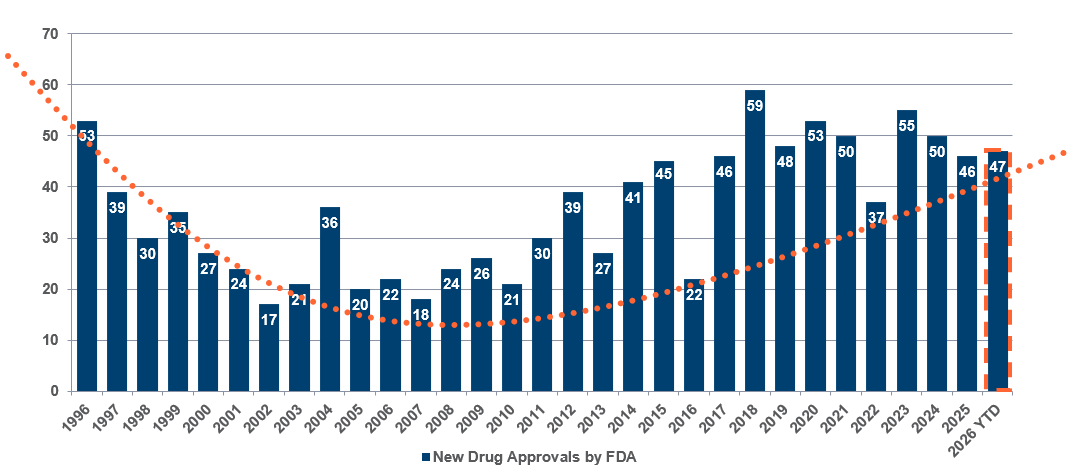 |
| Source: FDA, 30 October 2026. *Dashed line – Polar Capital estimates for 2026. Forecasts contained herein are for illustrative purposes only and does not constitute advice or a recommendation. Some information contained herein has been obtained from third party sources and has not been independently verified by Polar Capital. Neither Polar Capital nor any other party involved makes any express or implied warranties or representations. |
Portfolio positioning
We have made no significant changes to portfolio positioning in reaction to the midterm results. The portfolio is underweight (holds less than the benchmark) pharmaceuticals and overweight (holds more than the benchmark) life sciences tools and services, healthcare supplies and managed healthcare. We continue to look for growth opportunities across the healthcare industry.
Recent additions reflecting the diversity of opportunity have included Intuitive Surgical, Oruka Therapeutics and Gilead Sciences.
Intuitive Surgical is a leading protagonist in the field of robotic surgery and has experienced a significant fall in its valuation despite analysts raising earnings forecasts. Key drivers of a potential recovery could come from an acceleration in procedures following a high level of robotic surgery installations during the third quarter of 2026 and continued innovation to further distance itself from the competition.
US-based biotechnology company Oruka Therapeutics delivered strong clinical results for a pipeline asset for the treatment of moderate-to-severe psoriasis. Strong efficacy aside, the company’s proprietary technology is designed to produce ultra-long-lasting therapeutics that materially reduce the administration burden for patients.
The investment thesis for Gilead Sciences is primarily based on three pillars: (1) a core HIV business with a relatively high level of medium-term visibility; (2) an oncology business that could inflect in the near term driven by an asset for the treatment of multiple myeloma; and (3) an early-stage but evolving pipeline in the field of immunology and inflammation.
Outlook
The healthcare sector has been starting to show leadership within the market over recent months. The sector is supported by positive earnings revisions and undemanding valuations. The innovation engine is firing on all cylinders, the regulatory backdrop is supportive and the companies are successfully commercialising their assets.
Meanwhile, the longer-term drivers of the sector – an ageing population globally needing more healthcare, new product cycles and increasing M&A – remain intact. We continue to find attractive investment opportunities across the healthcare industry.
[1] Novel Drug Approvals for 2026 | FDA as at 18 November 2026.